
Tucked into the heart of Anza-Borrego Desert State Park — California’s largest state park at over 600,000 acres — the tiny, unincorporated community of Borrego Springs offers access to some of the most dramatic desert hiking in the American Southwest. Borrego Springs hikes range from easy, family-friendly nature walks through palm-shaded canyons to strenuous ridge climbs with sweeping views of the Salton Sea, the Laguna Mountains, and Mexico’s Sierra Juárez. With more than 110 miles of maintained trails, slot canyons carved into ancient seabeds, seasonal wildflower superbloom events, and year-round solitude that nearby San Diego trails simply can’t match, this desert destination deserves a permanent spot on every hiker’s list.
Here’s your complete trail-by-trail guide — organized by difficulty — along with the seasonal timing, gear, and safety knowledge you need to make the most of every mile.
Easy Borrego Springs Hikes (Under 3 Miles)
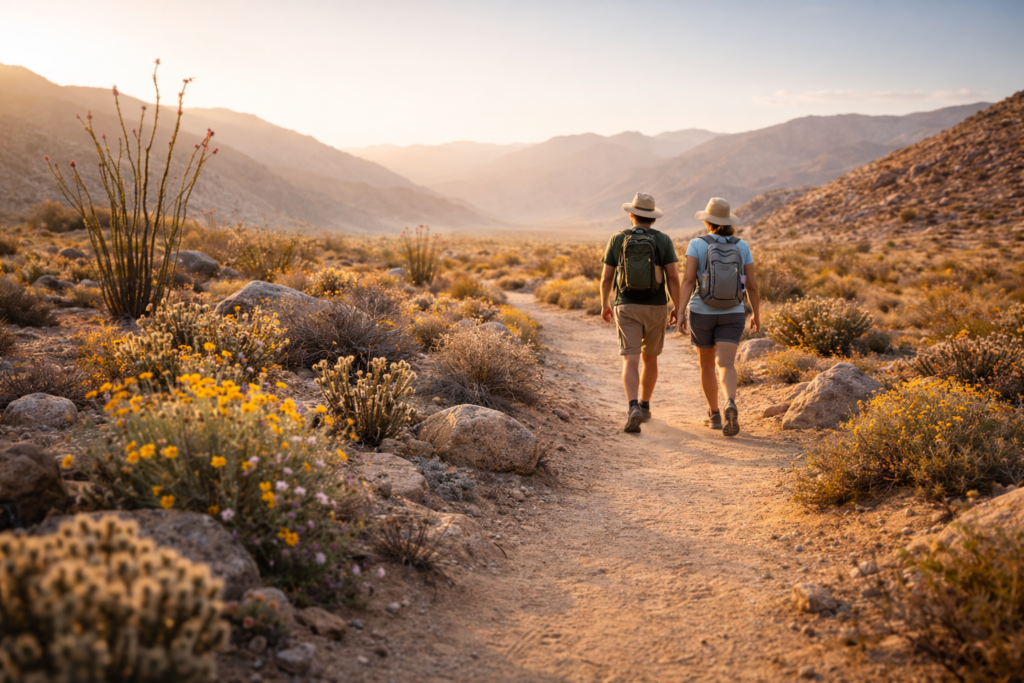
These trails are ideal for first-time desert hikers, families with young children, and anyone looking for a rewarding experience without significant elevation gain or scrambling.
1. Borrego Palm Canyon Trail
This is the signature hike of the region and the single best introduction to the Anza-Borrego landscape. The 3-mile out-and-back trail follows a rocky wash into a narrow canyon where a grove of native California fan palms — one of only 25 naturally occurring palm oases in North America — clusters around a seasonal waterfall. The trailhead begins at the Borrego Palm Canyon Campground, and interpretive signs along the first half-mile identify native plants including ocotillo, cholla, barrel cactus, and creosote bush.
Distance: 3 miles round trip | Elevation gain: 450 feet | Difficulty: Easy to moderate | Best season: November through April
2. Cactus Loop Trail
A short but visually rich 1-mile loop just off Henderson Canyon Road, this trail winds through one of the densest concentrations of barrel cactus and teddy bear cholla in the park. In spring, the surrounding flats can erupt in wildflowers. The terrain is flat and well-marked, making it accessible for hikers of all fitness levels.
Distance: 1 mile loop | Elevation gain: Minimal | Difficulty: Easy | Best season: October through April
3. Yaqui Well Nature Trail
This easy 1.5-mile loop passes through a mesquite woodland surrounding a natural seep that attracts desert wildlife. Early morning hikers frequently spot roadrunners, Gambel’s quail, coyotes, and mule deer. Numbered posts along the trail correspond to a self-guided brochure available at the trailhead.
Distance: 1.5 miles loop | Elevation gain: Minimal | Difficulty: Easy | Best season: Year-round (early morning recommended in summer)
Moderate Borrego Springs Hikes (3–6 Miles)
These trails introduce more elevation, route-finding, and exposure. Bring extra water and allow more time than the mileage alone might suggest — desert terrain is slower than mountain terrain.
4. The Slot — Borrego Badlands
One of the most photographed hikes in Anza-Borrego, The Slot is a narrow, winding passage carved through ancient lake-bed sediment by centuries of flash flooding. The canyon walls rise 30 feet overhead while the passage narrows to shoulder width in places. Access requires a short drive on Buttes Pass Road, which is passable for most high-clearance vehicles.
Distance: 1.5 miles round trip (with additional badlands exploration) | Elevation gain: 100 feet | Difficulty: Easy to moderate | Best season: November through March (avoid any day with rain in the forecast)
5. Wind Caves Trail
This moderately strenuous out-and-back trail climbs steadily from the desert floor to a series of sandstone formations sculpted by millennia of wind erosion into honeycomb-like cavities. The caves themselves are a photographer’s paradise, and the panoramic views of Borrego Valley and the Vallecito Mountains from the ridgeline are among the best in the park.
Distance: 3.6 miles round trip | Elevation gain: 1,000 feet | Difficulty: Moderate | Best season: November through March
6. Ghost Mountain — Marshal South Cabin
This hike traces the footsteps of Marshal South, a writer who built a hand-constructed adobe home atop Ghost Mountain in the 1930s and lived there with his family for 17 years. The trail climbs steeply through boulder fields to the cabin ruins, where interpretive panels tell the South family’s remarkable story. The summit views span Blair Valley, the Vallecito Badlands, and the distant Salton Sea.
Distance: 2 miles round trip | Elevation gain: 900 feet | Difficulty: Moderate (steep and rocky) | Best season: October through April
7. Hellhole Canyon to Maidenhair Falls
A rewarding canyon hike that follows a rocky wash upstream to a seasonal 25-foot waterfall draped in maidenhair fern — a startling sight in the middle of the desert. The route is unmaintained past the first mile and requires moderate scrambling over boulders. When water is flowing (typically January through March in good rain years), this is one of the most memorable Borrego Springs hikes available.
Distance: 5.5 miles round trip | Elevation gain: 900 feet | Difficulty: Moderate to strenuous | Best season: January through March (after rain)
Strenuous Borrego Springs Hikes (6+ Miles or Significant Elevation)
These are full-day commitments requiring solid fitness, desert navigation skills, and serious water capacity. Start at dawn and carry a minimum of one gallon of water per person.
8. Villager Peak
The most demanding summit hike accessible from Borrego Springs, Villager Peak rises to 5,756 feet above sea level from a trailhead at roughly 1,000 feet. The route follows a steep, exposed ridge with no shade and no reliable water sources. The reward is a commanding 360-degree view from the Salton Sea to the Pacific crest. This hike is only appropriate for experienced desert hikers in peak physical condition.
Distance: 14 miles round trip | Elevation gain: 5,000 feet | Difficulty: Extremely strenuous | Best season: November through February (start before sunrise)
9. Calcite Canyon and Mine
This route descends into a dramatic slot canyon lined with calcite crystal formations, then continues to a World War II-era calcite mine used to supply optical-grade crystals for military gunsights. The approach requires a rough dirt road, and the canyon involves some scrambling and drop-offs. A GPS device or detailed map is strongly recommended.
Distance: 4 miles round trip | Elevation gain: 900 feet (with steep descents) | Difficulty: Moderate to strenuous | Best season: November through March
10. Cougar Canyon to Indian Canyon Loop
A backcountry loop through two lush palm oases connected by rugged ridgeline terrain. This route sees very few hikers and delivers the kind of deep-desert solitude that draws people to Borrego Springs in the first place. A wilderness permit is not required, but self-registration at the trailhead is expected.
Distance: 8 miles loop | Elevation gain: 1,800 feet | Difficulty: Strenuous | Best season: November through March
Bonus: Wildflower and Off-Trail Experiences
11. Henderson Canyon Wildflower Walk
Not a formal trail, but during superbloom years — most recently in 2017 and 2019 — Henderson Canyon Road becomes one of the most spectacular wildflower viewing corridors in California. Desert sunflowers, sand verbena, dune primrose, and desert lilies carpet the valley floor in vivid color. Park along the road and walk the flats freely.
Best season: Late February through mid-March in strong bloom years | Difficulty: Easy
12. Borrego Springs Sculpture Trail (Sky Art Drive)
While not a hike in the traditional sense, this free, open-air sculpture garden features over 130 massive metal sculptures by artist Ricardo Breceda scattered across the desert. Many visitors park at various pullouts and walk between sculptures, combining a 2- to 4-mile casual walk with a one-of-a-kind art experience. The juxtaposition of prehistoric creatures, serpents, and fantastical figures against the stark desert backdrop is extraordinary.
Distance: Variable (2–4 miles walking) | Difficulty: Easy | Best season: Year-round
Essential Gear and Safety Tips for Desert Hiking in Borrego Springs
Desert hiking demands a different preparation mindset than mountain or coastal trails. These guidelines apply to every hike on this list.
Water is non-negotiable. Carry a minimum of one liter per hour of hiking during cool months and up to 1.5 liters per hour when temperatures exceed 85°F. Dehydration and heat-related illness are the leading causes of rescue calls in Anza-Borrego Desert State Park.
Sun protection is critical. Wear a wide-brimmed hat, UV-protective sunglasses, and mineral sunscreen. Long, lightweight sleeves provide better protection than sunscreen alone on extended desert exposure.
Watch for flash floods. Slot canyons and washes can flood with little warning, even from rainstorms miles away. Never enter a narrow canyon if rain is forecast anywhere in the region. Check the National Weather Service Coachella Valley forecast before every hike.
Respect rattlesnakes. Western diamondback and red diamond rattlesnakes are active in Borrego Springs from March through October. Stay on trail, watch where you place your hands and feet, and give any snake you encounter a wide berth.
Cell service is unreliable. Most of Anza-Borrego has no cell coverage. Download offline maps, carry a paper backup, and consider a personal locator beacon or satellite messenger for remote hikes.
Start early. Even in winter, afternoon temperatures can reach the upper 70s to mid-80s. Starting at dawn gives you the coolest, most comfortable hiking window and the best light for photography.
Frequently Asked Questions
What is the best time of year for Borrego Springs hikes?
The ideal hiking season runs from November through March, when daytime temperatures average 65°F to 80°F and nights cool into the 40s. December through February is the sweet spot for comfortable all-day hiking. Summer temperatures regularly exceed 110°F, making most trails dangerous between June and September. If you visit during wildflower season — typically late February through mid-March — you may catch one of California’s legendary desert superblooms.
Are Borrego Springs hikes dog-friendly?
Anza-Borrego Desert State Park is one of California’s most dog-friendly parks. Dogs are allowed on most trails as long as they are kept on a leash no longer than six feet. Exceptions include designated wildlife protection areas, which are posted at trailheads. Bring extra water for your dog, protect their paws from hot sand and sharp rocks, and be aware that cactus spines — especially cholla segments — are a common hazard for curious pets.
Do I need a pass or permit to hike in Borrego Springs?
Day-use access to Anza-Borrego Desert State Park is free. No entry fee, parking pass, or wilderness permit is required for day hiking. If you plan to camp at a developed campground such as Borrego Palm Canyon, reservations are recommended during peak season (November through April) and fees apply. Backcountry camping is free and allowed in most areas of the park with self-registration.
How do I get to Borrego Springs?
Borrego Springs is approximately 85 miles northeast of San Diego, about a two-hour drive via CA-78 East or S-22. The town is also accessible from Palm Springs (about 75 miles south via CA-86 and S-22). There is no public transit service to Borrego Springs, so a personal vehicle is essential. A high-clearance vehicle is recommended for accessing remote trailheads on unpaved roads, though most popular hikes are reachable with a standard car.
Is Borrego Springs good for beginner hikers?
Absolutely. Trails like the Cactus Loop, Yaqui Well Nature Trail, and the Borrego Palm Canyon Trail offer short distances, clear markings, and minimal elevation gain — perfect for beginners. The key for any first-time desert hiker is to carry more water than you think you need, start early in the morning, and choose a shaded canyon hike over an exposed ridge walk during warmer months.
Can I see the metal sculptures and hike in the same day?
Yes — and most visitors do. The Borrego Springs sculpture trail is located right in town along Borrego Springs Road and surrounding desert flats. Plan to spend an hour driving and walking among the sculptures, then head to a trailhead for your main hike. Borrego Palm Canyon, The Slot, and the Wind Caves are all within a 20- to 40-minute drive from the sculptures.
Start Planning Your Borrego Springs Hiking Trip
With trails for every skill level, uncrowded canyons, free park access, and a dark-sky community that makes post-hike stargazing unforgettable, Borrego Springs delivers one of the most complete desert hiking experiences in the West. The only thing between you and these trails is a decision to go.
Book your accommodations early if you’re visiting between November and March — the handful of hotels, vacation rentals, and campgrounds in Borrego Springs fill quickly during peak season. Download offline trail maps before you leave cell range. Pack twice the water you think you need. And give yourself at least two full days — one for the canyons and one for the ridgelines — to experience what makes this corner of the California desert so extraordinary.
Your next great hike is waiting in Borrego Springs. All you have to do is show up.